CSS如何判斷鼠標(biāo)進(jìn)入的方向-創(chuàng)新互聯(lián)
這篇文章給大家分享的是有關(guān)CSS如何判斷鼠標(biāo)進(jìn)入的方向的內(nèi)容。小編覺(jué)得挺實(shí)用的,因此分享給大家做個(gè)參考,一起跟隨小編過(guò)來(lái)看看吧。

在之前某一個(gè)前端技術(shù)群里,有一個(gè)群友說(shuō)他面試的時(shí)候遇到了一個(gè)問(wèn)題,就是面試官讓他用純 CSS 來(lái)實(shí)現(xiàn)一個(gè)根據(jù)鼠標(biāo)移動(dòng)位置覺(jué)得物體移動(dòng)方向的 DEMO。
給出的初始結(jié)構(gòu)如下:
<style>
body {
padding: 2em;
text-align: center;
}
.block {
position: relative;
display: inline-block;
width: 10em;
height: 10em;
vertical-align: middle;
}
.block_content {
position: absolute;
top: 0;
left: 0;
width: 100%;
height: 100%;
text-align: center;
line-height: 10em;
background: #333;
color: #FFF;
}
</style>
<p class="text">從不同方向使鼠標(biāo)指針移過(guò)下面的內(nèi)容</p>
<p>↓</p>
<span>→ </span>
<div class="block">
<div class="block_content">
Hover me!
</div>
</div>
<span> ←</span>
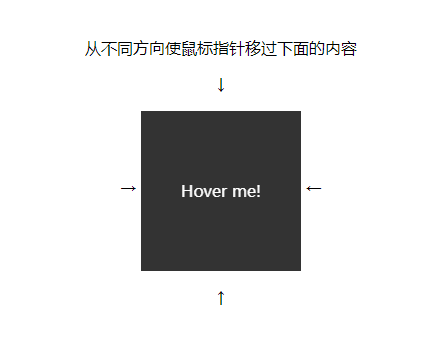
<p>↑</p>效果圖如下:
實(shí)現(xiàn)
凈會(huì)問(wèn)這種不實(shí)用又跟業(yè)務(wù)沒(méi)啥關(guān)系的問(wèn)題,氣抖冷,中國(guó)前端什么時(shí)候才能真正的站起來(lái)。 謝謝面試官提出的好問(wèn)題,我會(huì)努力實(shí)現(xiàn)出來(lái)的。
所以這個(gè)功能真的能用純 CSS 實(shí)現(xiàn)嗎?
答案是可以的,首先我們來(lái)分解下思路。
CSS 鼠標(biāo)事件
首先根據(jù)題干,我們知道這題是需要用到鼠標(biāo)操作的,JS 里我們有各種mouse 事件,但同樣的,CSS 我們也有:hover 。
這題我們需要利用到的選擇器就是:hover 了
判斷方向
判斷方向的功能便是本題的核心。
從題圖上來(lái)看,其實(shí)已經(jīng)給了我們方向的指引,就是告訴我們鼠標(biāo)要通過(guò)四個(gè)箭頭的方向進(jìn)入。
然后就是如果要純 CSS 來(lái)實(shí)現(xiàn),就是我們的鼠標(biāo)必須要觸碰到某個(gè)關(guān)鍵節(jié)點(diǎn),而且這個(gè)節(jié)點(diǎn)的某個(gè)表現(xiàn)一定是可以代表這個(gè)方位的。
這就是題目給出的兩個(gè)隱藏條件。
所以我們來(lái)嘗試下實(shí)現(xiàn)。
首先要通過(guò):hover 來(lái)觸碰到這個(gè)關(guān)鍵節(jié)點(diǎn),而且是要在箭頭指向的方向下觸碰觸發(fā),那么我們可以在箭頭所指的方向都加上一個(gè)能被觸碰到的物體,例如這樣:
<style>
.block_hoverer {
    position: absolute;
    width: 100%;
    height: 100%;
    z-index: 1;
}
.block_hoverer:nth-child(1) {
    background: red;
}

.block_hoverer:nth-child(2) {
    background: lime;
}

.block_hoverer:nth-child(3) {
    background: orange;
}

.block_hoverer:nth-child(4) {
    background: blue;
}
</style>
<div class="block">
    <div class="block_hoverer">上</div>
    <div class="block_hoverer">下</div>
    <div class="block_hoverer">左</div>
    <div class="block_hoverer">右</div>
    <div class="block_content">
        Hover me!
    </div>
</div>
效果如下:
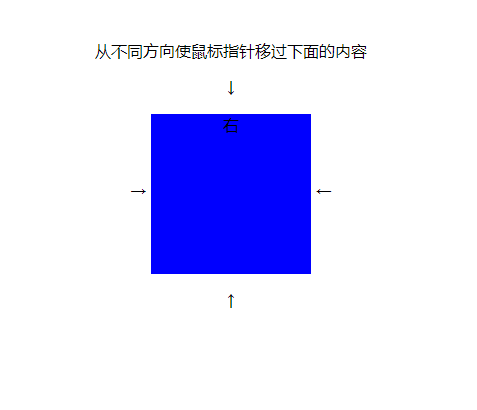
我們可以發(fā)現(xiàn),除了右塊 之外,都被遮住了,嗯,正常現(xiàn)象。
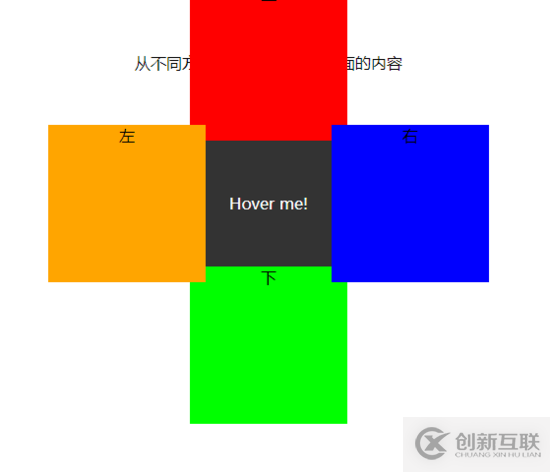
接下來(lái)我們只需要讓這幾個(gè)塊退到邊緣即可。
代碼如下:
.block_hoverer {
  position: absolute;
  z-index: 1;
  width: 100%;
  height: 100%;
  transition: all 0.3s ease;
}
.block_hoverer:nth-child(1) {
  background: red;
  top: -90%;
}

.block_hoverer:nth-child(2) {
  background: lime;
  top: 90%;
}

.block_hoverer:nth-child(3) {
  background: orange;
  left: -90%;
}

.block_hoverer:nth-child(4) {
  background: blue;
  left: 90%;
}
效果如下:
然后我們加上過(guò)渡:
.block_hoverer {
  transition: all 0.3s ease;
}
.block_hoverer:hover {
  opacity: 1;
  top: 0;
  left: 0;
}
效果如下:
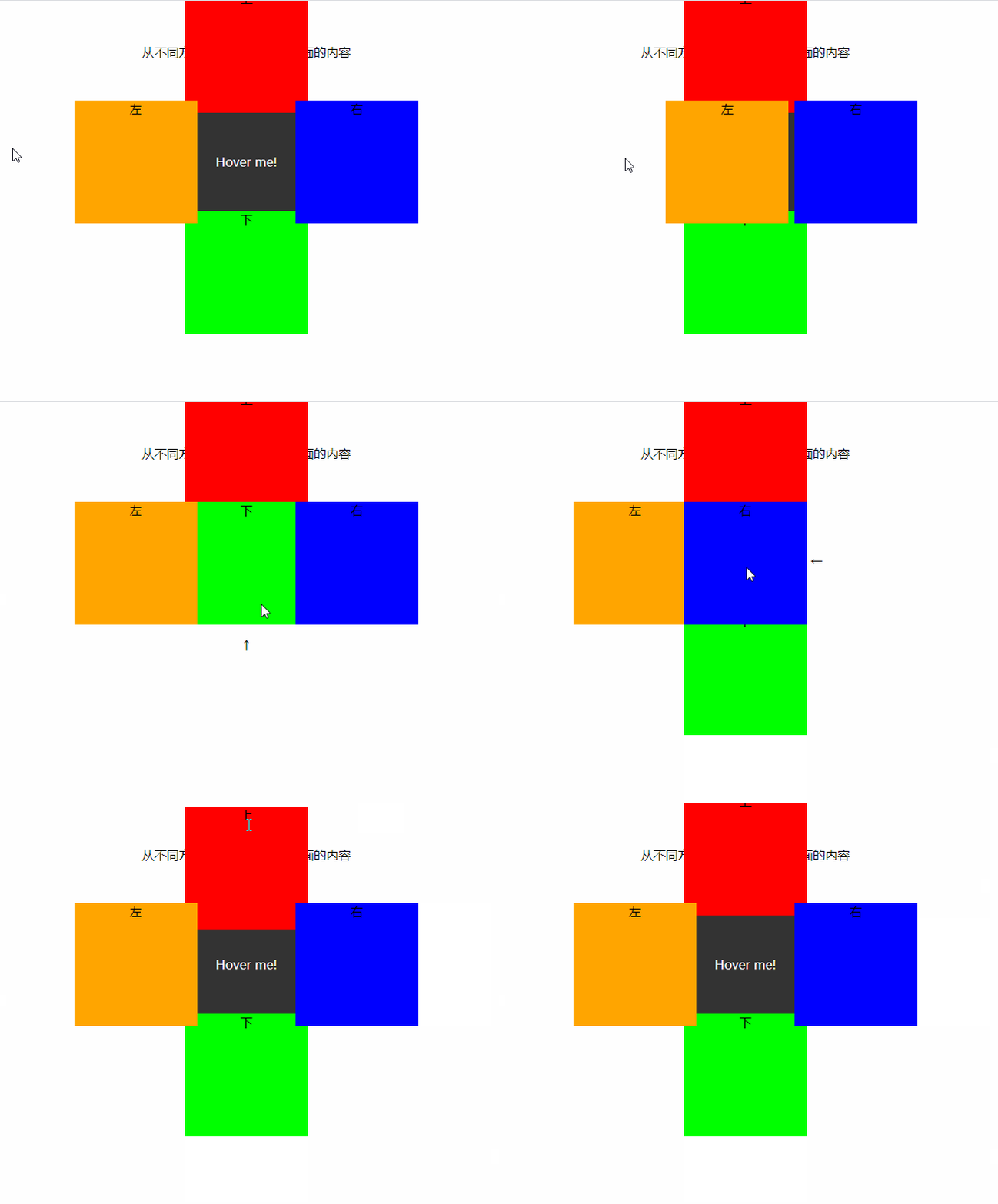
一步就是隱藏起來(lái):
.block {
  position: relative;
  display: inline-block;
  overflow: hidden;
  width: 10em;
  height: 10em;
  vertical-align: middle;
}
.block_hoverer {
  opacity: 0;
}
.block_hoverer:hover {
  opacity: 1;
}
效果如下:
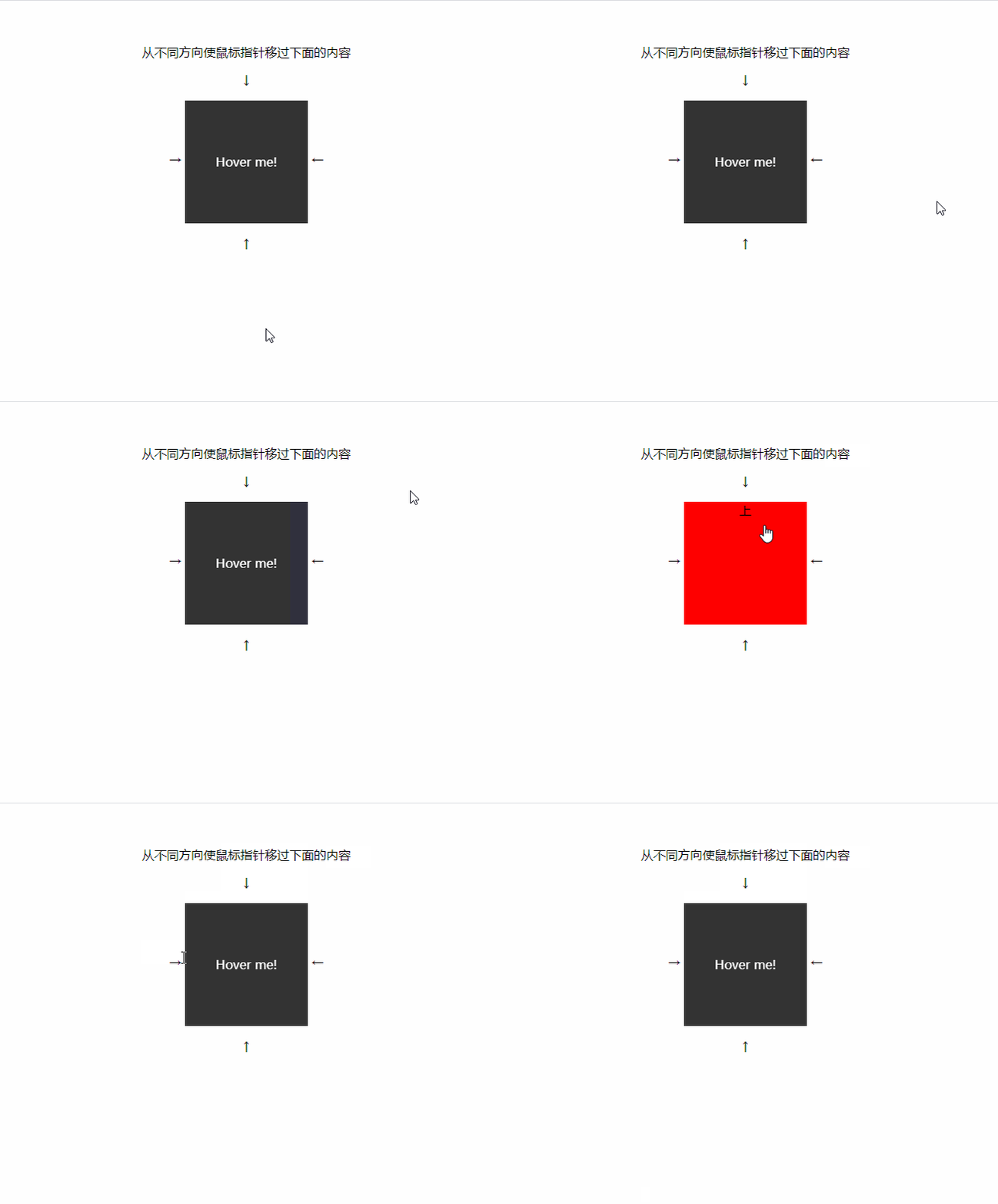
所以我們有完整代碼如下:
<style>
body {
padding: 2em;
text-align: center;
}
.block {
position: relative;
display: inline-block;
overflow:hidden;
width: 10em;
height: 10em;
vertical-align: middle;
transform: translateZ(0);
}
.block_hoverer {
position: absolute;
z-index: 1;
width: 100%;
height: 100%;
opacity: 0;
transition: all .3s ease;
}
.block_hoverer:nth-child(1) {
background: red;
top: -90%;
}
.block_hoverer:nth-child(2) {
background: lime;
top: 90%;
}
.block_hoverer:nth-child(3) {
background: orange;
left: -90%;
}
.block_hoverer:nth-child(4) {
background: blue;
left: 90%;
}
.block_hoverer:hover {
opacity: 1;
top: 0;
left: 0;
}
.block_content {
position: absolute;
top: 0;
left: 0;
width: 100%;
height: 100%;
text-align: center;
line-height: 10em;
background: #333;
color: #FFF;
}
</style>
<body>
<p class="text">從不同方向使鼠標(biāo)指針移過(guò)下面的內(nèi)容</p>
<p>↓</p>
<span>→ </span>
<div class="block">
<div class="block_hoverer">1</div>
<div class="block_hoverer">2</div>
<div class="block_hoverer">3</div>
<div class="block_hoverer">4</div>
<div class="block_content">
Hover me!
</div>
</div>
<span> ←</span>
<p>↑</p>
</body>完整效果可以查看魚(yú)頭的codepen
感謝各位的閱讀!關(guān)于“CSS如何判斷鼠標(biāo)進(jìn)入的方向”這篇文章就分享到這里了,希望以上內(nèi)容可以對(duì)大家有一定的幫助,讓大家可以學(xué)到更多知識(shí),如果覺(jué)得文章不錯(cuò),可以把它分享出去讓更多的人看到吧!
文章標(biāo)題:CSS如何判斷鼠標(biāo)進(jìn)入的方向-創(chuàng)新互聯(lián)
鏈接分享:http://chinadenli.net/article48/sheep.html
成都網(wǎng)站建設(shè)公司_創(chuàng)新互聯(lián),為您提供自適應(yīng)網(wǎng)站、品牌網(wǎng)站建設(shè)、網(wǎng)頁(yè)設(shè)計(jì)公司、網(wǎng)站設(shè)計(jì)公司、響應(yīng)式網(wǎng)站、網(wǎng)站制作
聲明:本網(wǎng)站發(fā)布的內(nèi)容(圖片、視頻和文字)以用戶投稿、用戶轉(zhuǎn)載內(nèi)容為主,如果涉及侵權(quán)請(qǐng)盡快告知,我們將會(huì)在第一時(shí)間刪除。文章觀點(diǎn)不代表本網(wǎng)站立場(chǎng),如需處理請(qǐng)聯(lián)系客服。電話:028-86922220;郵箱:631063699@qq.com。內(nèi)容未經(jīng)允許不得轉(zhuǎn)載,或轉(zhuǎn)載時(shí)需注明來(lái)源: 創(chuàng)新互聯(lián)
猜你還喜歡下面的內(nèi)容
- 基于vue的管理系統(tǒng)頁(yè)面模板vueelementui教程?-創(chuàng)新互聯(lián)
- VUE中v-html不能觸發(fā)點(diǎn)擊事件怎么辦-創(chuàng)新互聯(lián)
- php中查詢數(shù)據(jù)表是否存在的方法-創(chuàng)新互聯(lián)
- 虛擬主機(jī)代碼如何上傳-創(chuàng)新互聯(lián)
- 黑馬java基礎(chǔ)篇day01-創(chuàng)新互聯(lián)
- python廣播機(jī)制29歲想學(xué)python,有哪些建議?-創(chuàng)新互聯(lián)
- 在java中如何查看版本-創(chuàng)新互聯(lián)

- 淺談定制網(wǎng)站制作的好處有哪些? 2022-12-12
- 定制網(wǎng)站對(duì)企業(yè)有哪些意義? 2021-10-21
- 為什么定制網(wǎng)站價(jià)格那么貴? 2021-12-16
- 【網(wǎng)站建設(shè)】透析定制網(wǎng)站:細(xì)說(shuō)網(wǎng)站建設(shè)流程 2022-05-03
- 滁州定制網(wǎng)站建設(shè):為什么大型企業(yè)都做定制網(wǎng)站? 2021-08-18
- 選擇高端定制網(wǎng)站建設(shè)的理由 2018-01-20
- 定制網(wǎng)站優(yōu)缺點(diǎn)顏色在設(shè)計(jì)中的作用 2022-07-08
- 如何通過(guò)定制網(wǎng)站設(shè)計(jì)去打造品牌? 2023-02-22
- 成都網(wǎng)站建設(shè)全面解析:定制網(wǎng)站的優(yōu)劣,這一次終于全明白了! 2022-08-07
- 定制網(wǎng)站建設(shè)需要解決的問(wèn)題 2018-02-01
- 企業(yè)為何愿意出高價(jià)定制網(wǎng)站? 2022-11-29
- 什么是定制網(wǎng)站?創(chuàng)新互聯(lián)告訴你! 2021-10-06